Royal Mirage Night is a cheap body spray with an allergen list as long as the can
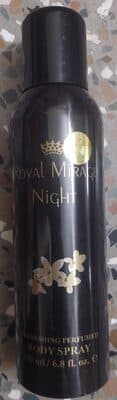
Royal Mirage Night is a budget aerosol body spray in the AXE/Brut tradition, and like most of that category, the scent is the entire pitch. The verified INCI confirms a formula that's mostly denatured alcohol, hydrocarbon propellants, and a fragrance load declaring an unusually long roster of known sensitizers — including two materials that have since been banned or restricted in the EU. That's enough to make it hard to recommend for anyone with reactive skin.
What it is
This is a pressurized body spray, not an eau de toilette. The base is Alcohol Denat. with butane, isobutane, and propane (listed as 'Propone' on the can) as propellants, plus monopropylene glycol, water, and ethylhexylglycerin to carry the perfume oils. Ethylhexylglycerin here is doing double duty as a mild preservative booster and skin-conditioning humectant. It's designed for clothing or below-the-neck skin — a light, short-lived scent rather than a long-wear fragrance.
Key ingredients (and red flags)
The active here is, functionally, the perfume. What stands out on the verified label is how many EU-declared fragrance allergens appear: amyl cinnamal, amyl cinnamyl alcohol, benzyl alcohol, benzyl benzoate, benzyl cinnamate, benzyl salicylate, cinnamal, cinnamyl alcohol, citral, citronellol, coumarin, eugenol, farnesol, geraniol, hexyl cinnamal, hydroxycitronellal, isoeugenol, limonene, linalool, anise alcohol, and alpha-isomethyl ionone. That's effectively the full allergen roster on a single can.
Two entries deserve specific call-outs. Hydroxyisohexyl 3-cyclohexene carboxaldehyde — Lyral, or HICC — has been banned in EU cosmetics since August 2021 because of its high contact-allergy rate; its presence suggests an older or non-EU-compliant formulation. Butylphenyl methylpropional (Lilial/BMHCA) is also EU-prohibited as of 2022 on reproductive-toxicity grounds. Add Evernia prunastri (oakmoss) and Evernia furfuracea (treemoss) — both IFRA-restricted classic perfumery materials with well-documented sensitization risk — and methyl 2-octynoate, another IFRA-capped allergen, and you have a fragrance built largely on materials modern perfumery has engineered around.
The ingredient list also contains multiple typos ('Propone', 'Monoproplene Glycol', 'Cinnamyl Alcohole', 'Geraniot', 'Ethythexlglycerin', 'Evernia Furfuacea'), which doesn't affect performance but doesn't inspire confidence in QC either.
Who it's for, who should skip
If you have no history of fragrance sensitivity, tolerate AXE-tier body sprays without issue, and want a cheap nighttime scent for clothing, this will do what it says. The materials list reads as a sweet-amber-mossy chypre, on-trend for the price.
Skip it if you have eczema, rosacea, perfume contact dermatitis, or any history of reacting to scented products. Don't spray it on freshly shaved skin or near the face, and keep it away from the underarms right after shaving or depilatory use — the alcohol/propellant base plus this allergen load is a predictable irritant combo.
The verdict
As a scent-delivery system at a few dollars a can, Royal Mirage Night is fine. As a formulation in 2024, it's behind the curve: it carries effectively the full EU allergen roster plus two materials (HICC and Lilial) that are outright banned in EU cosmetics, alongside oakmoss and treemoss. Buy it knowing exactly what it is — a clothing spray, not a skincare-adjacent product — or spend slightly more on a current-formula drugstore EDT.
Discussion
0 comments- No comments yet.