Living Nature's Sensitive Skin Moisturiser is gentle, but thin on actives
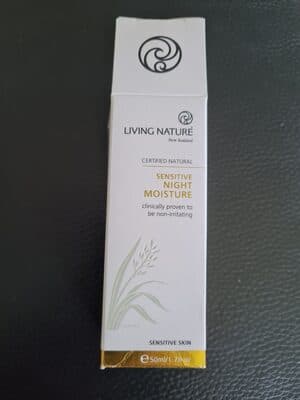
Living Nature's Sensitive Skin Moisturiser is the kind of stripped-back formula that makes sense for genuinely reactive skin — no fragrance, no essential oils, no botanical extracts known to sensitize — but the trade-off is a product that doesn't really do anything beyond softening and sealing.
What it is
A New Zealand-made daily moisturizer pitched at sensitive and reactive skin. The structure is a simple oil-in-water cream: water, two plant oils, jojoba esters, glycerin, and then the emulsifier system — cetearyl olivate and sorbitan olivate (the Olivem 1000 pairing), thickened with xanthan gum and stabilized with cetyl palmitate and sorbitan palmitate. That's a recognized gentle, non-PEG emulsion system that tends to feel cushiony rather than slippery.
Preservation comes from sodium levulinate and sodium anisate, a mild naturally-derived combination active mainly against bacteria and with weaker antifungal coverage. That's consistent with the sensitive-skin positioning, and it's also why Living Nature flags a six-month post-opening window — shorter than the 12M PAO you'd expect from a conventionally preserved cream.
Key ingredients
The emollient backbone is avocado oil and virgin coconut oil in the second and third slots, supported by jojoba esters and glycerin. Avocado oil is a sensible pick for dry, sensitized skin — high in oleic acid and sterols, generally well tolerated. Coconut oil is where reasonable people disagree: it's deeply occlusive and comforting, but it's also one of the more frequently flagged comedogenic oils (commonly rated 4/5), and here it sits high in the formula rather than as a trace. If you're acne-prone, that matters.
Harakeke (Phormium tenax) extract is a New Zealand flax with some preliminary data around polysaccharide-driven hydration, but it sits mid-list after the emulsifiers and clinical evidence remains thin. Grapefruit (Citrus grandis) fruit extract appears second-to-last — at that position it's unlikely to be photosensitizing or doing meaningful work; it's effectively a label-friendly inclusion.
What's notably absent: niacinamide, panthenol, ceramides, cholesterol, or any of the barrier-repair ingredients that have become standard in sensitive-skin moisturizers from CeraVe, La Roche-Posay, or Avène. There are no peptides and no humectants beyond glycerin. This is a comfort cream, not a barrier cream.
Who it's for
Dry, reactive, fragrance-intolerant skin that wants something soft and uncomplicated will probably get along with this. It's also a sensible pick for anyone stripping their routine down to identify a trigger ingredient — the list is short enough to actually reason about.
Skip it if you're acne-prone (coconut oil this high is a real risk), if you want active treatment for redness or compromised barrier (the formula is too basic), or if you want a long shelf life — the six-month post-opening window is short for a daily moisturizer.
The verdict
This is a clean, well-tolerated cream with a transparent 14-ingredient list and no obvious irritants beyond the coconut-oil caveat. But at its typical price point, you're paying a premium for natural-positioning rather than for formulation sophistication. If your skin is sensitive and you specifically want to avoid synthetic preservatives and fragrance, it earns its place. If you want a sensitive-skin moisturizer that also rebuilds the barrier, a $16 tub of CeraVe or a tube of La Roche-Posay Toleriane will outperform it on every measurable axis.
Discussion
0 comments- No comments yet.