The Derma Co's Sali-Cinamide serum: a workmanlike combo for mild acne
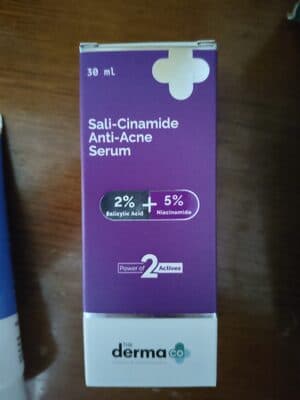
The Derma Co's Sali-Cinamide Serum bundles two of the most evidence-backed actives for oily, breakout-prone skin — salicylic acid and niacinamide — into one lightweight serum. The verified INCI confirms the bones of a sensible anti-acne formula, alongside a few inclusions that don't quite match the marketing.
What it is
A leave-on anti-acne serum aimed at people dealing with congestion, active blemishes, and post-acne marks. The pitch is two-in-one: BHA exfoliation from salicylic acid plus barrier and sebum support from niacinamide, with alpha arbutin tucked in to fade dark spots. Salicylic acid appears twice on the INCI — once in seventh position and again after the oils — an unusual labeling pattern that typically reflects a split addition during manufacturing. With no disclosed percentage, the positioning points to a total in the standard OTC 1–2% range.
Key ingredients
Niacinamide sits third on the list, behind only water and propanediol, which puts it at a meaningful concentration — plausibly in the 4–5% zone where there's solid evidence for reducing sebum, redness, and uneven tone. Salicylic acid is the headline exfoliant and is reinforced lower down by willow bark extract, a natural source of salicin. That's a reasonable BHA backbone, buffered by sodium hydroxide to keep the pH in a tolerable range.
Alpha arbutin is a smart inclusion for post-inflammatory hyperpigmentation, but it's listed after the oils and below glycerine, suggesting a token amount rather than the 1–2% range where it actually shifts pigment. Centella asiatica and allantoin are sensible calming additions, sodium hyaluronate handles light hydration, and the xylitylglucoside/anhydroxylitol/xylitol blend (Aquaxyl) adds a small humectant boost. Rosa canina fruit extract sits in a solvent blend high up and reads more as a marketing flourish than a meaningful actor.
The choices that give us pause: Olea Europaea (olive) fruit oil and Carthamus Tinctorius (safflower) seed oil appear directly after propylene glycol, in a serum sold for acne-prone skin. Olive oil has a moderate comedogenicity reputation and a high oleic acid content that can disrupt the barrier in acne-prone users; neither oil is where we'd want to see lipids in a BHA product. The percentages read as small, but their inclusion is a puzzling call for the stated use case. We'd also note propylene glycol and triethanolamine as potential sensitizers for reactive skin, and isostearamidopropyl ethyldimonium ethosulfate — a cationic conditioning agent more typical of haircare — is an odd-but-not-alarming pick to give the serum some slip.
Who it's for
Best suited to oily and combination skin with mild to moderate acne, occasional blackheads, and lingering marks from old breakouts. The niacinamide concentration is high enough to do real work over 8–12 weeks of consistent use, and the BHA level is gentle enough for near-daily application.
Skip it if you have very dry or reactive skin (the BHA plus propylene glycol and triethanolamine can be drying or sensitizing for some), if your skin reacts poorly to plant oils, or if you already use a dedicated BHA and don't want to double up.
The verdict
A serviceable, affordable serum that hits the main pillars of an anti-acne routine without doing anything special. At this price band it earns a qualified recommendation, but Paula's Choice 2% BHA paired with a standalone niacinamide serum (or The Ordinary's Niacinamide 10% + Zinc 1%) will outperform it for not much more money — and without the olive-oil-in-an-acne-serum question mark. A solid budget pick, not a standout.
Discussion
0 comments- No comments yet.